There Are Several Methods Of Demagnetisation:
a. Aperture coil with A.C.
This is a coil of several hundred turns which is connected to the mains. The object to be demagnetised is placed inside the coil and slowly withdrawn to a distance of at least 1.5 metres away from the coil, or the object is left stationary in the coil and the current gradually turned down to zero. This is generally accepted as the most commonly used method for demagnetisation.
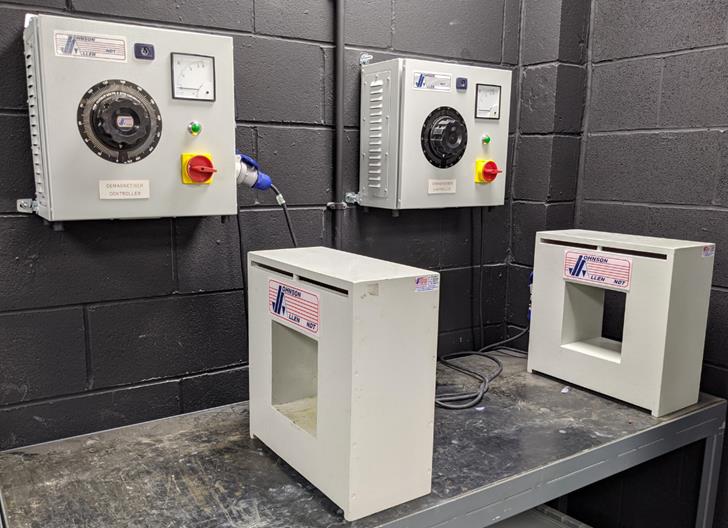
b. Aperture coil with reversing D.C.
This method is similar to the A.C. coil but the demagnetising field penetrates further in the test piece. The current direction is reversed periodically, but at decreasing amplitude until the residual magnetism is removed. Using a reversing and decreasing power supply will achieve the most effective method for demagnetisation.
c. A.C. electromagnetic yokes (wiper brush)
These can be used to demagnetise large areas in situ. The yoke is usually stroked along the length of a weld and then drawn away to a distance exceeding 450mm. If the component were a large casting or wrought product then the yoke would usually be stroked across the surface in a circular motion and then drawn away to a distance exceeding 450mm.
d. A.C. current flow
When using a current flow technique, such as that found on a bench unit, demagnetisation can be carried out by using A.C. current and slowly reducing the current flowing to zero. A variation on this method is the peak and drop technique where the current is initially introduced at a higher value than the magnetising current then reduced to zero, the peak current is then re-introduced at successively decreased values whilst returning to zero current after each peak current.
e. Flexible cable (induction system)
If a portable induction type system is available, demagnetisation can be carried out by wrapping 2 or 3 turns of the cable around the object to be demagnetised and gradually reducing the A.C. current to zero. If magnetisation is carried out using the induction coil, the object under test is automatically demagnetised if the current is reduced to zero before the unit is switched off.
f. Hammering/Dropping
The physical vibration resulting from hammering or dropping a magnetised piece of material can result in the randomising of domains (when carried out with the component in an east to west direction). Although this is usually forbidden due to the risk of structural damage and discontinuities occurring.
g. Heat treatment
This is the only process which will completely demagnetise a specimen back to zero, known as the grand state. It is not necessary to demagnetise if a heat treatment process is to follow magnetic particle inspection and the specimen is to be heated beyond its curie point. This is the temperature at which the material changes from ferromagnetic to paramagnetic and so loses its ferromagnetic properties and theoretically would not be able to be magnetised until cooled sufficiently, where it regains its ferromagnetic properties. The Curie point varies widely depending on alloy composition.
For example:
- The Curie point for nickel containing 1% silicon is 320ºC
- The Curie point for nickel containing 5% silicon is 450ºC
- The Curie point for ferrous alloys ranges from about 650 to 870ºC
- The Curie point for cobalt is 1130ºC, iron 770ºC, nickel 358ºC
The transition from ferromagnetic to paramagnetic at the Curie point reverses on cooling and the material becomes ferromagnetic in an un-magnetised condition. Studies have shown that the transition is from a rearrangement of magnetic domains. Demagnetisation by heating through the Curie point is the most thorough demagnetisation possible but because of its expense and metallurgical effects is not commonly used.
When a material is to be demagnetised, by methods other than heat treatment, the initial demagnetising field strength must be stronger than the residual field.
Demagnetisation may be easy or hard, depending on the test piece material i.e. is the material soft or hard? In this instance, hard refers to the magnetic properties not a physical characteristic i.e. magnetically hard means high reluctance and low permeability.
Circular magnetism is generally considered to be harder to demagnetise than longitudinal magnetism because theoretically the field is contained within the test piece with no poles and it is therefore difficult to measure the field strength.
To fully demagnetise a test piece, it should be carried out in an east-west direction so that the earth’s magnetic field will not interfere. By laying a test piece north south, the earth’s magnetic field will weakly magnetise it. The earth’s magnetic field is typically quoted as 0.3g to 0.6g depending on where you are on the surface of the earth.
The level to which a specimen must be demagnetised may be laid down in an MT test procedure or specification.
To check that a test piece has been demagnetised satisfactorily, the amount of residual magnetism remaining may be checked with a calibrated field strength meter (such as Gauss Meter or Hall Effect Meter) or existence may be confirmed with other types of field indicator.